The best AI toolkit for a finance professional is not the longest list of applications. It is a controlled set of tools that reduces review time without weakening evidence, confidentiality or accountability. The right question is not whether a tool is impressive; it is whether the output can be checked and owned by a professional.
Start with five recurring jobs: research and first-draft analysis, document extraction, reconciliation and exception handling, management reporting, and client communication. Map current time spent, error points and approval steps before choosing software. If the baseline is unclear, a purchase becomes an expense without a business case.
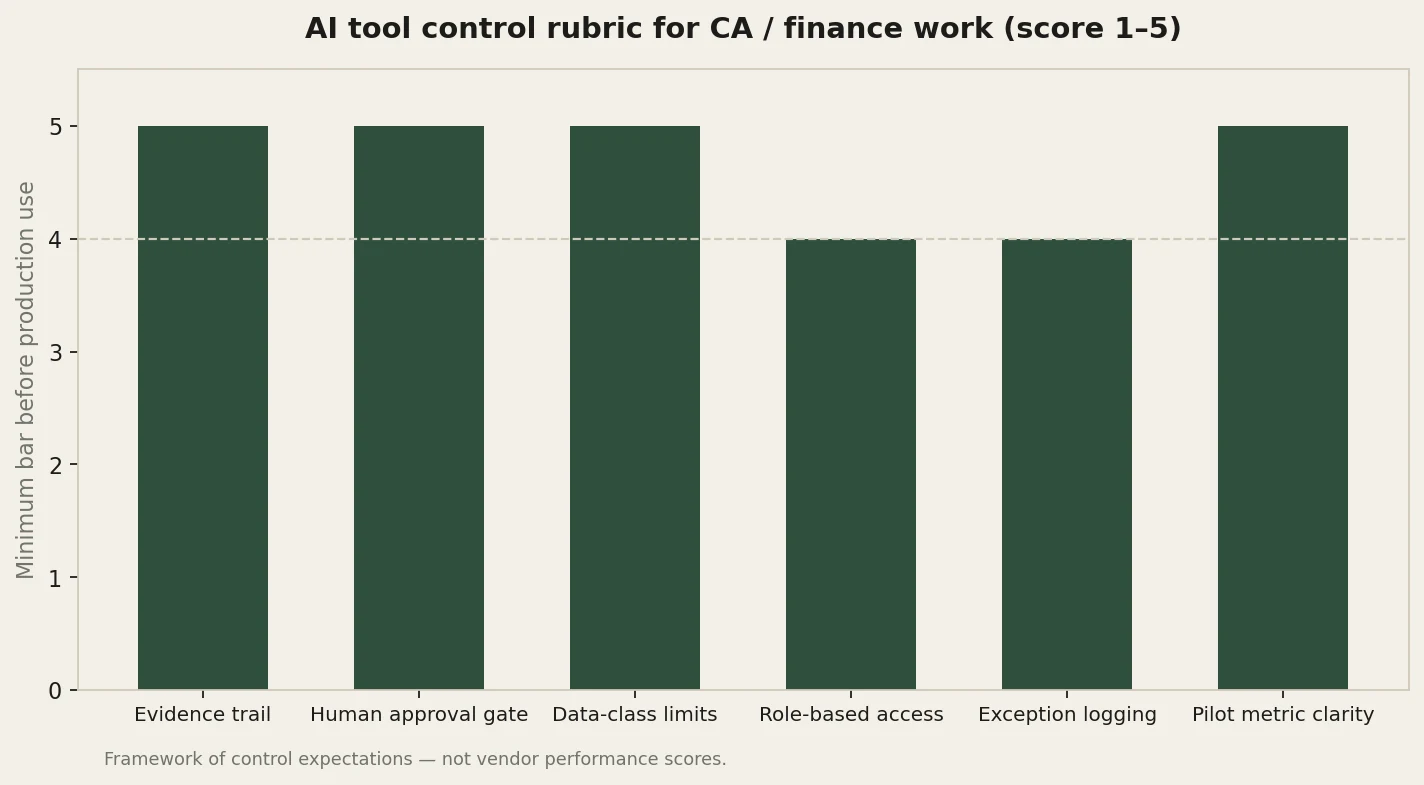
Control rubric before any production use
| Control gate | Pass looks like | Fail looks like | Score (1–5) |
|---|---|---|---|
| Evidence trail | Source docs and outputs linked | Chat history is the only record | ___ |
| Human approval gate | Named reviewer for material conclusions | Auto-send to client or ledger | ___ |
| Data-class limits | Written rules on what may leave the firm | Anything pasted into any model | ___ |
| Role-based access | Least privilege by client/matter | Shared logins | ___ |
| Exception logging | Mismatches queued and reviewed | Silent overwrite | ___ |
| Pilot metric clarity | Hours, exceptions or turnaround named | “Feels faster” | ___ |
A practical shortlist to evaluate (not a ranking)
Notion is useful as a knowledge and operating layer for client checklists, SOPs, meeting records and reusable working papers. Payback looks like fewer missed steps and clearer ownership — confirm capabilities on the Notion product page.
Synder is relevant where online sales data must be synchronised and reconciled across commerce and accounting systems. Test with your real fee and refund patterns; see the Synder site.
Writesonic can support research and content workflows, but every externally published or client-facing output needs human review and source checks — start from the Writesonic site.
Align tool governance with an established risk vocabulary. The NIST AI Risk Management Framework is a useful public reference for mapping risks, controls and measurement — adapt it to your firm; do not treat it as a certification of any vendor.
Four-week rollout pattern
One workflow, one owner, one metric. Measure hours saved, exception rates, turnaround time and review rework. If results are positive and controls hold, document the pattern before expanding. AI should draft, classify, summarise or flag; a responsible professional should approve the result.
Monday-morning checklist
- Name the single workflow in scope this week.
- Confirm which data classes are banned from external models.
- Review the exception queue — clear or escalate every open item.
- Spot-check two AI-assisted outputs against source documents.
- Update the pilot metric log before the weekly ops huddle.
Disclaimer
Educational and informational only — not personalised professional or investment advice. For investor-protection education, see SEBI investor education. Tool availability, pricing and privacy terms change; evaluate each product against your policies before adoption.
Map jobs before you map vendors
Chartered accountants and finance professionals are flooded with “AI for accounting” marketing. Most of it skips the only question that matters: which recurring job will this change on Monday, under whose review, with what evidence trail? Research drafting, document extraction, reconciliation exceptions, management commentary and client updates are different risk classes. Treat them separately in your shortlist.
Write a one-page workflow for the first job: inputs, transformation, outputs, owner, exceptions, and where the official record lives. Tools that cannot sit cleanly inside that page are entertainment, not infrastructure.
Where AI helps — and where it must not decide
Helpful patterns: classifying documents, drafting first-pass commentary from structured packs, flagging mismatches, summarising long threads for human review, and accelerating checklist tracking. Dangerous patterns: unsupervised tax positions, filing without review, silent ledger posts, client advice generated from incomplete context, and any workflow where nobody can explain how the answer was produced.
Professional accountability does not transfer to a model. If you would not sign the output, do not let the workflow emit it as final. That rule alone eliminates a surprising amount of shiny risk.
Building a defensible pilot
Choose one team, one workflow, one metric, and a four-week window. Baseline hours or exception counts before you turn features on. Keep a parallel path for material items if risk is high. Log exceptions in a shared place so patterns become visible. At the end, decide keep, redesign or kill — in writing.
Align your control language with public frameworks where helpful. The NIST AI Risk Management Framework is a widely referenced public resource for thinking about risk, governance, mapping and measurement. It does not endorse specific commercial tools; use it to structure your own policy conversations.
Client communication and trust
If AI assists client-facing writing, disclose internally who reviewed it. Keep tone, facts and recommendations under human ownership. For investor-facing education topics outside your engagement letters, point clients to primary regulators where appropriate — for example SEBI’s investor education materials — rather than letting generated copy invent authority.
Inside the firm, update engagement quality checklists so AI-assisted work is visible in review, not hidden. Surprise is the enemy of professional trust.
Procurement questions that save renewals later
Before annual commitments, ask: where does our data go, how long is it retained, can we turn off training on our content, how do we export evidence, what happens on model changes, and who supports exception handling? Put answers beside your control rubric. A tool that cannot answer plainly is a governance problem waiting for audit season.
Also price the human gate. Reviewer time is part of total cost. If seniors spend more hours checking low-quality drafts than they saved, the pilot failed even if juniors felt faster.
The payback filter: will this tool earn its place?
I use a blunt filter. If a tool cannot improve one of cycle time, exception rate, review hours, close days, or collections visibility — within a four-week pilot — it stays on the wishlist. Demo quality is irrelevant. Monday-morning usefulness is not.
Start with work that is high-volume, rules-heavy and already owned: document intake, reconciliation matching, first-draft management commentary, client checklist tracking, and research synthesis with mandatory review. These are not glamorous. They are where hours hide.
This is where finance teams are already finding value. Gartner's 2024 survey found 58% of finance functions using AI, and the most common uses were intelligent process automation (44%) and anomaly and error detection (39%). Those are checkable, high-volume jobs, not judgement calls.
One more filter before any tool touches client data: check the business terms. OpenAI says its business products are not used to train its models by default, and Microsoft makes a similar commitment for Microsoft 365 Copilot. Those terms apply to business accounts, not personal ones, and staff use personal ones more than most firms assume: 78% of AI users in Microsoft and LinkedIn's 2024 Work Trend Index said they bring their own tools to work. For the controls that go with this, see the AI controls checklist for CA firms.
Frequently asked questions
What are the best AI tools for chartered accountants?
There is no single best tool. Choose by the job, such as research drafts, document extraction or reconciliation support, and by where client data lives and what the vendor’s business terms say about training, retention and access.
Is it safe for CAs to use ChatGPT with client data?
Only under an approved business account with suitable data terms, after classifying the data and deciding what must be redacted or kept out entirely. Consumer accounts should not be used for confidential client material.
Will AI tools replace accounting software?
No. AI tools sit alongside the ledger and practice software to speed up drafting, extraction and review. The books of account and sign-off stay in your controlled systems.
Sources
- NIST AI Risk Management Framework
- SEBI investor education
- Notion product
- Synder
- Writesonic
- Gartner — Survey shows 58% of finance functions using AI in 2024 (11 September 2024)
- Journal of Accountancy — Gartner finance AI use cases (September 2024)
- OpenAI — Business data privacy, security and compliance
- Microsoft Learn — Enterprise data protection in Microsoft 365 Copilot
- Microsoft and LinkedIn — 2024 Work Trend Index