AI for chartered accountants in India is not a race to install the largest model. It is a controlled change to how CA firms and finance teams research, extract, reconcile, report and communicate — without weakening evidence, confidentiality or professional judgement. This hub is written for partners, CFOs and practice leaders who want CA AI implementation in India to show up in the week’s work, not only in a strategy slide.
I write as Pratik Bajoria, Chartered Accountant, ex-Big 4, and founder of Findost. The lens is practical: structured workflows, measurable controls, and YMYL caution. Nothing here invents client metrics or promises regulatory outcomes. Use it as an implementation map, then verify tools and policies against your own practice.
What “AI for CA firms India” should mean in 2026
Three jobs dominate early value: faster first drafts of analysis and memos under review; document extraction into structured working papers; and exception-led reconciliation or compliance checklists. Prediction theatre and unsupervised client advice are late-stage ideas — if they belong at all. The firms that climb search and win trust will publish and operate with that sequencing, not with hype.
Target entities for this page — AI for chartered accountants India, CA AI implementation India, AI for CA firms India — only matter if the content behind them is cite-worthy: clear definitions, a rubric others can reuse, and links to deeper playbooks on tooling, pilots and build-versus-buy.
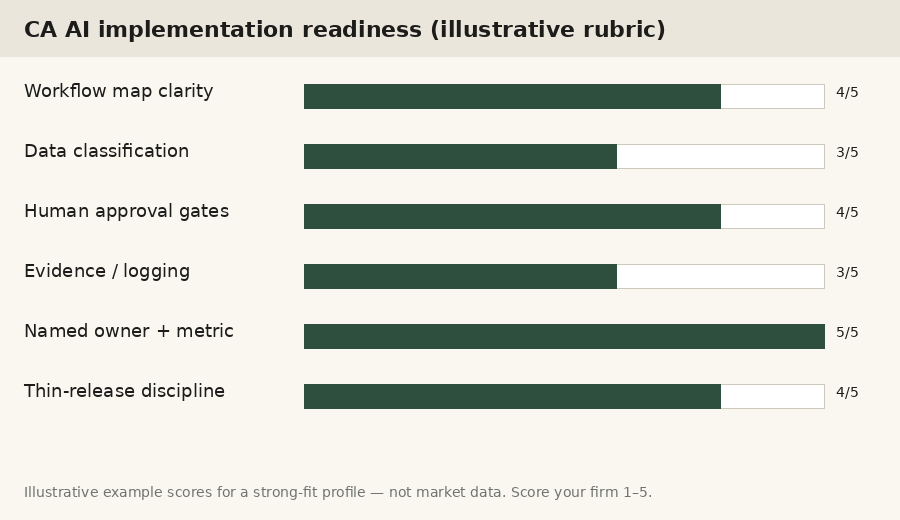
| Axis | 1 = weak fit | 5 = strong fit | Your score |
|---|---|---|---|
| Workflow clarity | Tribal knowledge only | Five-line map exists for priority jobs | ___ |
| Controls | Outputs go straight to clients/books | Human gate + logging defined | ___ |
| Data | Anything pasted into consumer tools | Classes + approved environments | ___ |
| Metrics | No baseline | Named metric reviewed weekly | ___ |
| Scope | Transformation programme | One thin release funded | ___ |
A CA-led implementation sequence
1. Map five recurring jobs. Research and first-draft analysis, document extraction, reconciliation and exceptions, management or client reporting, and routine communication. For each, write input, decision, output, owner and definition of good. Blank lines mean you are not ready to buy.
2. Classify data. Client identity, unpublished financials, and advice drafts are restricted by default. Consumer chatbots are not an approved environment for restricted classes. Approved tools need access control, retention clarity and exportable logs.
3. Design human gates before automation. Decide what a person must approve before something becomes a deliverable, a filing support pack or a ledger-adjacent entry. An unauditable answer is not a professional deliverable.
4. Fund one thin release. One workflow, one team, one metric, two to four weeks, stop conditions in writing. Review weekly. Document the pattern if it works; stop if it does not.
5. Only then expand tooling. Read the deeper guides on best AI tools for chartered accountants and finance professionals, why corporate AI pilots stall, and build vs buy for AI tooling. Tool lists without gates are shopping lists.
Where Indian CA practices should be careful
Professional work sits in YMYL territory. Do not let keyword pressure push unverifiable claims onto your site or into client memos. Keep ICAI and firm quality standards in view; AI does not replace the signing professional. For securities-market adjacent work, treat SEBI’s public materials as part of your compliance reading list — not as a substitute for counsel. Prefer primary sources when you cite regulation.
Internal links worth keeping open while you plan: the free AI Opportunity Scorecard, the scoped AI Opportunity Audit, and discovery via a conversation on measurable P&L use cases.
How CA firms in India usually waste the first six months
The pattern is familiar. A partner sees a demo. An associate is told to “try ChatGPT on research”. Someone buys three overlapping licences. Nobody names the metric. Busy season arrives and the experiment dies. Six months later the firm concludes “AI does not work for us”, when what failed was the operating design.
Another failure mode is treating AI as a marketing slogan for the practice website while the delivery system stays unchanged. That may win a few enquiries; it will not survive peer review or a difficult client file. Cite-worthy implementation content — and cite-worthy delivery — both require the same discipline: narrow scope, evidence, named owners.
A third failure mode is copying Silicon Valley tooling narratives into Indian practice economics. Staffing mixes, software stacks, GST and MCA filing calendars, and client confidentiality expectations differ. Import frameworks; do not import fantasy ROI slides. Budget for review time and exception handling on the same sheet as licences.
What “good” looks like after ninety days
You should be able to show one completed thin release with: a five-line workflow map, a baseline sketch, a dual ownership record, an exception log, and a weekly metric review note. You should also be able to say what you declined — which pilots you refused because the gate or metric was missing. That refusal list is as important as the success story.
From there, expand only along the five-job map. Keep a shared register of AI-assisted workflows. Link each live item to evidence locations. Revisit build-versus-buy when volume or data sensitivity changes. Do not expand because a vendor quarter-end discount appeared.
Partners should also agree four one-page rules once at firm level: ownership, data classes, human gates, logging. Then let each service line fund its own thin release inside those rules. Central theatre committees without P&L ownership rarely ship.
Operating cadence that survives busy season
AI that only works in a quiet week will die in filings season. Bake the thin release into the Monday checklist: owner, metric, exception path, data the tool may see, weekly review. Use a workspace for the register and evidence links; keep the books in the books. If a pilot cannot explain itself in five minutes on Monday, it is not ready.
For multi-office practices, start with one office and one service line. Publish the pattern internally before you franchise it. The second deployment should be cheaper than the first because the evidence trail already exists — not because you bought a larger platform licence.
How to brief your partnership without a forty-page deck
One page is enough. State the five-job map, the four rules, the single thin release you will fund, the metric, the stop conditions, and the review date. Attach the readiness rubric with your own scores — not illustrative bars from a vendor PDF. If partners cannot agree that page in one meeting, you are not ready to buy software.
Then publish the same page internally so associates know what “good” looks like before busy season. Clarity beats enthusiasm. Enthusiasm without gates becomes another zombie licence.
Monday-morning checklist
- Pick one job from the five-job map and write the five-line workflow.
- Classify data and block restricted classes from consumer tools.
- Name dual owners and the weekly metric before buying licences.
- Ship a thin release with stop conditions; review weekly.
- Read tooling, pilots and build-vs-buy guides before expanding scope.
- Keep a written list of pilots you declined and why.
Sources
- NIST AI Risk Management Framework
- SEBI — investor / regulatory portal
- ICAI — Institute of Chartered Accountants of India
Educational commentary for CA and finance leaders in India — not personalised professional, tax, legal or investment advice. Confirm tools, privacy terms and firm policies before deployment.