Notion can be valuable to finance professionals when it is used as a structured knowledge and workflow layer — not as an alternative ledger. Its best role is to make recurring work visible: who owns the close, which evidence is pending, what a policy means, and what management decided last month.
If your team already has an approved accounting system, leave the numbers there. Point Notion at source records, attachments and owners. Duplicating every balance into a pretty database creates reconciliation risk and a false sense of control.
What a practical finance workspace contains
A durable setup usually has databases for recurring close tasks, SOPs and policies, entity or client records, decision and issue logs, and a research or source register. A month-end template should include reconciliation, ageing, accruals, tax checkpoints, management commentary and sign-off — with dates, owners and “done when” criteria written in plain language.
Dashboards in Notion should answer operating questions: what is blocked, what is overdue, which decisions are open. They should not pretend to be the management accounts pack. Link out to the system of record for figures.
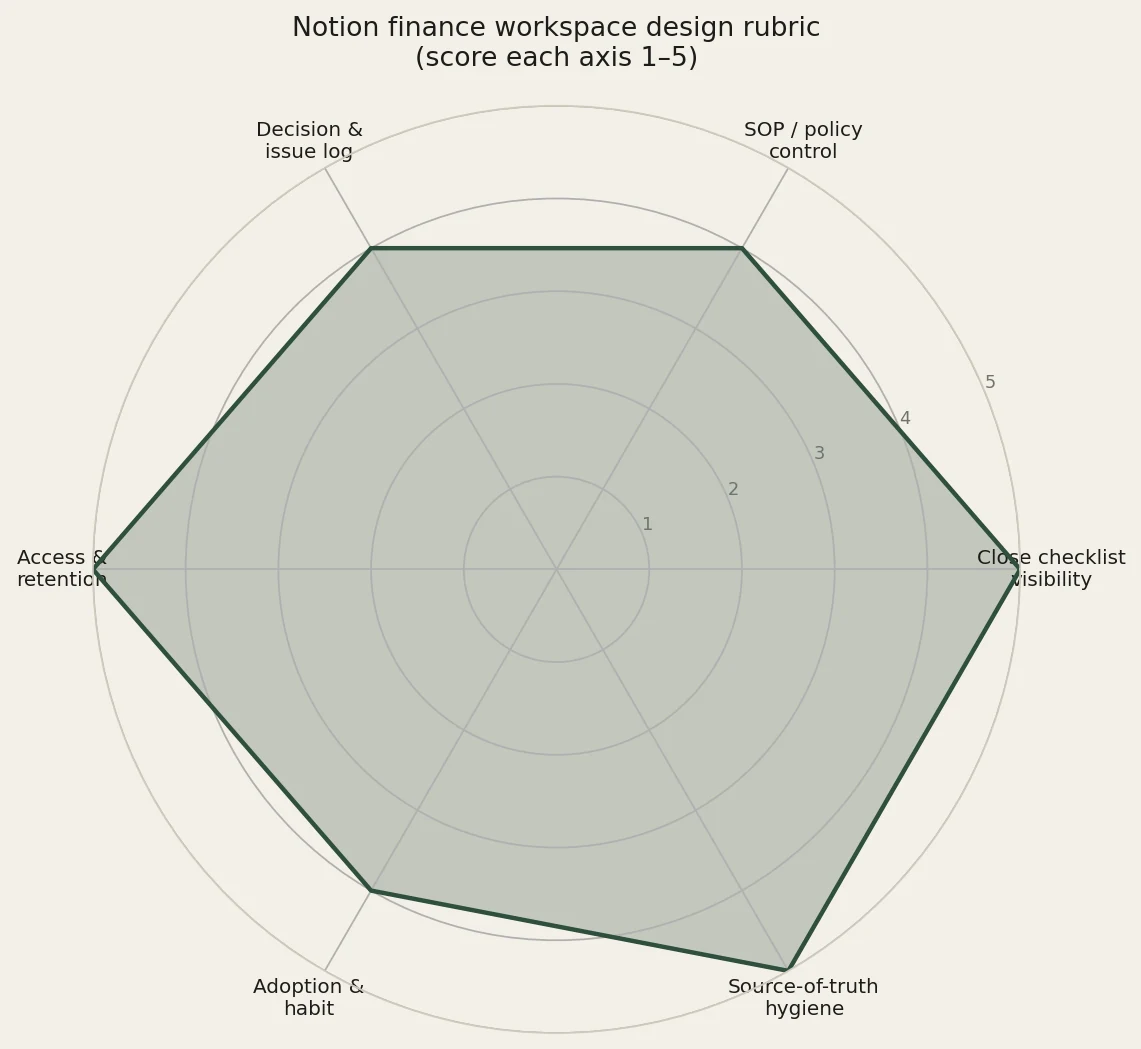
Workspace design rubric (score 1–5)
| Axis | What “5” looks like | Your score |
|---|---|---|
| Close checklist visibility | Every close step has owner, due date and evidence link | ___ |
| SOP / policy control | Approved versions only; draft vs live is obvious | ___ |
| Decision & issue log | Material issues and decisions are searchable with owners | ___ |
| Access & retention | Role-based access; sensitive pages restricted; retention agreed | ___ |
| Adoption & habit | Team updates Notion as part of the close, not after the fact | ___ |
| Source-of-truth hygiene | Figures live in ledger/BI; Notion holds process and context | ___ |
Controls when AI features enter the workspace
Store only what the workspace needs. Restrict sensitive pages. Avoid unnecessary personal or financial data in AI features. Review integrations and define retention. Point to approved source records rather than pasting client schedules into prompts. For a structured way to think about AI risk, governance and measurement, see the NIST AI Risk Management Framework — then map those ideas to your firm’s own policies.
Rollout that finance teams actually finish
Use Notion first for one internal process — typically month-end close or client onboarding checklists. Measure completion time, missed tasks, unresolved issues and adoption for four weeks. Expand only after the team has built the habit. Templates without owners become museum pieces.
Monday-morning checklist
- Open this period’s close database view filtered to “not done”.
- Clear blockers older than three business days or escalate with an owner.
- Confirm evidence links still point to the system of record.
- Log any policy or process change in the decision log before the team improvises.
- Check access on one sensitive page as a spot control.
Disclaimer and product verification
This article is educational and does not constitute accounting, tax, legal or investment advice. Verify product capabilities, privacy terms, pricing and partner status on the Notion product page before purchase.
Templates that survive month-end pressure
A finance template earns its keep when a tired analyst can open it on day two of the close and know exactly what “done” means. Write exit criteria in verbs: reconcile bank to ledger, attach statement, note open items over an agreed threshold, mark reviewer. Avoid vague statuses like “in progress” without a next action and date.
For multi-entity or multi-client firms, separate entity properties from task properties. Do not force every client into identical noise; keep a shared close skeleton and allow lightweight client-specific checkpoints. Archive completed periods rather than endlessly lengthening one database view.
Research and working-paper templates should capture the question, sources consulted, conclusion, residual uncertainty and reviewer. That structure is more valuable than decorative cover pages. When AI helps draft summaries, the template still needs a human sign-off field.
Dashboards versus management accounts
Notion dashboards are excellent for process health: overdue close tasks, open issues by severity, SOP pages awaiting review. They are a poor home for statutory numbers unless you have a deliberate, controlled export from the ledger — and even then, beware dual maintenance. Prefer charts that answer “are we on track to close?” over charts that restate P&L.
If leadership wants commentary, store the narrative next to the KPI dictionary and the action log. Link to the BI or accounting pack for figures. When someone asks “which number is right?”, the answer must be unambiguous.
Security and retention habits for CA firms
Classify pages: public internal, confidential, highly restricted. Guest access should be rare and time-bounded. Turn off broad sharing links for client work. Agree how long close evidence and decision logs are retained, and where the long-term archive lives if Notion is not that archive.
Review AI and integration settings with the same seriousness as any cloud productivity suite. If a feature sends content to an external model, document allowed data classes. Train juniors that “paste everything into AI” is a control failure, not a productivity tip.
Measuring whether Notion is working
Useful leading indicators: percentage of close tasks completed on time, count of issues open beyond SLA, time to find the latest approved SOP, and whether new joiners can run a checklist without Slack archaeology. If those do not improve after a fair trial, simplify the workspace before adding more databases.
Resist the urge to rebuild the entire firm operating system in week one. One process, documented, adopted, measured — then the next. That sequencing is how knowledge tools become infrastructure rather than abandoned side projects.
Notion as a control layer, not a second ledger
Use Notion for ownership and evidence trails; keep the books in the books. Finance teams that try to turn a workspace into a second ledger usually end up with two incomplete truths and a painful close. The useful pattern is narrower: Notion as the control layer around the ledger — checklists, owners, evidence links, exception logs and operating reviews.
A control layer answers questions the general ledger is not designed to answer quickly. Who owns this reconciliation? Where is the evidence pack for last month’s revenue cut-off? Which AI or automation exceptions are still open? What is the status of the close calendar? Those are process truths. The ledger remains the system of record for balances and journals.
Practical Notion uses that hold up under audit scrutiny include: month-end and quarterly close checklists with assignees and due dates; a register of reconciliations with links to exported workpapers; an exception log for automation or AI-assisted matches; a decision log for policy judgements; and a simple RAID or issue list for systems projects. Templates help only when they mirror how your team already works. Fancy dashboards that nobody updates are decoration.
What not to do is equally clear. Do not re-key trial balances into Notion tables and treat them as authoritative. Do not store unrestricted client or payroll files in a workspace without access review. Do not let “updated in Notion” replace posting and review in the accounting system. Confidentiality and retention policies still apply; classify data before you invite a wider team in.
A thin release looks like this. Pick one close checklist for a single entity. Link each step to the real workpaper location. Run it for one month beside the old email chase. Measure whether aged open items and chase emails fell. If yes, extend to reconciliations and exception logs. If not, simplify the template before buying more Notion structure.
For CA firms serving clients, the same pattern applies internally: engagement checklists, review notes indexes, and knowledge pages for recurring procedures — with client files staying in the approved DMS. The brand of workspace matters less than the discipline of ownership and evidence.