Most conversations I have about “AI automation in India” start with a tool and end with a pilot nobody uses. The businesses that get value tend to do it the other way round. They pick one workflow that already hurts, write down who owns it and what good looks like, and only then decide what to automate. I am a chartered accountant and worked at a Big 4 firm before founding Findost, so I come at this from the controls side: if you cannot explain the output to an auditor, a customer or a regulator, it is not ready.
This page is the index for everything I have written on automation outside the CA practice itself: sales and customer workflows, operations, governance and tooling. For the profession-specific guides, see AI for chartered accountants in India; for close, reconciliation and ROI, see AI implementation for finance teams.
What AI automation should mean for an Indian business
Useful automation is narrow and checkable. In practice that usually means one of five jobs:
- Enquiries and customer messages: sorting and drafting first replies on WhatsApp and email, with a person approving anything that commits the business.
- Documents: pulling fields out of invoices, purchase orders, KYC files or property documents and flagging what is missing.
- Reconciliations and exceptions: matching marketplace, bank and ledger data and sending only the mismatches to a reviewer.
- CRM and pipeline hygiene: logging calls, updating stages and nudging follow-ups so the sales record reflects reality.
- Recurring reporting: first drafts of MIS commentary from controlled data, reviewed before anyone sees them.
What these have in common is a defined input, a repeatable transformation and an owner who can judge the result. That is also why finance is often the first function to move: Gartner’s 2025 survey found 59% of finance leaders using AI in their function, up from 37% in 2023.
By the numbers
The scale of the opportunity, and the size of the gap between using AI and getting a return from it. Each figure links to its source and date.
9.78 crore
MSME registrations on Udyam and the Udyam Assist Platform as of 6 October 2026.
Source: PIB factsheet, 6 October 2026
31.1%
of GDP and 48.58% of exports come from MSMEs, according to the Economic Survey 2025-26.
Source: PIB factsheet, 6 October 2026
Nearly 9 in 10
respondents report regular AI use in at least one business function, but 44% say AI is scaling across the enterprise.
37%
of respondents attribute at least some EBIT impact to AI, essentially unchanged from 2025.
Why so many automation pilots stall
The pattern is well documented. Gartner predicted that at least 30% of generative AI projects would be abandoned after proof of concept by the end of 2025, citing poor data quality, weak risk controls, rising costs and unclear business value. In my experience the fix is boring: a baseline taken before the tool arrives, a named owner, a review gate and a weekly metric. I have written that up as the Monday morning test for any AI workflow and in why most corporate AI pilots never reach production.
The Indian rules that shape the design
Two sets of rules come up in almost every Indian automation project.
- Personal data: the Digital Personal Data Protection Act, 2023 applies to digital personal data of individuals, and the government notified the DPDP Rules on 14 November 2025. Customer chats, KYC files and employee data all count, so map what personal data each workflow uses before it reaches an AI tool.
- Regulated entities: if you are a bank, NBFC or other RBI-regulated entity, read the RBI’s FREE-AI committee report (August 2025). Even outside financial services it is a sensible checklist of what a regulator would expect to see written down: a board-approved policy, an inventory of AI uses and an incident process.
For a framework-neutral way to structure the risk work, the NIST AI Risk Management Framework is free and practical. None of this is legal advice; confirm your position on your own facts.
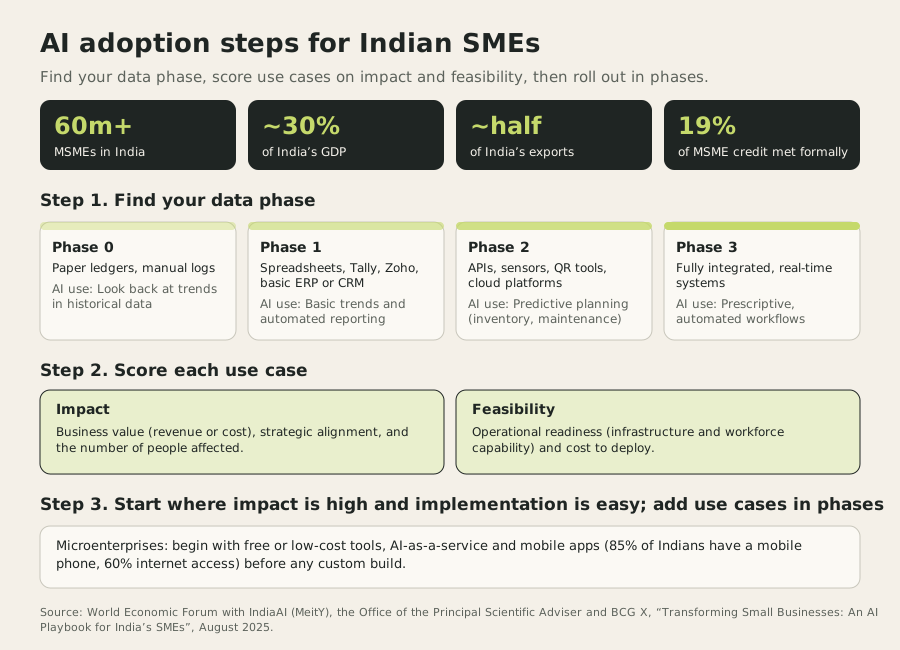
Text version of this infographic
- Context: India has more than 60 million MSMEs, contributing about 30% of GDP and about half of exports; only 19% of MSME credit demand is met through formal sources.
- Step 1, find your data phase: phase 0 is paper ledgers and manual logs (AI can look back at historical trends); phase 1 is spreadsheets, Tally, Zoho or a basic ERP or CRM (basic trends and automated reporting); phase 2 is APIs, sensors, QR tools and cloud platforms (predictive planning); phase 3 is fully integrated real-time systems (prescriptive, automated workflows).
- Step 2, score each use case: impact (business value, strategic alignment, people affected) and feasibility (operational readiness, cost to deploy).
- Step 3: start where impact is high and implementation is easy, then add use cases in phases. Microenterprises should begin with free or low-cost tools, AI-as-a-service and mobile apps; 85% of Indians have a mobile phone and 60% have internet access.
A 90-day sequence that survives contact with the business
- Days 1–30: pick one workflow, record today’s volumes, cycle time and error rate, and decide which steps must stay human.
- Days 31–60: run the automation in parallel with the existing process, with every output reviewed and every exception logged.
- Days 61–90: compare against the baseline and make a written go, adjust or stop decision. Only then widen the scope.
The full version, with an opportunity scoring method, is in a 90-day AI opportunity audit without the theatre. If you are weighing a custom build against an off-the-shelf tool, read build vs buy AI tooling first.
Every guide in this hub
Planning, governance and pilots
- The Monday Morning Test for Any AI Workflow
- A 90-Day AI Opportunity Audit Without the Theatre
- Why Most Corporate AI Pilots Never Reach Production
- Build vs Buy: A Decision Framework for AI Tooling
- AI Governance for Mid-Market Teams Who Do Not Have a Chief AI Officer
Customer, sales and operations workflows
- WhatsApp Automation That Still Feels Like Customer Care
- Ecommerce Reconciliation: Where Automation Helps and Where It Lies
- Best Accounting Automation Software for Ecommerce: A CA Comparison
- Real Estate AI: Start With Leads and Documents, Not Prediction
- How to Build a Lead-Generation System Using AI and Email Automation
CRM, research and tool choices
- HubSpot vs Spreadsheet CRM: The Real Switching Cost
- Zoho CRM, HubSpot and Your Books: A CRM-to-Accounting Handoff for Indian SMEs
- HubSpot vs Zoho CRM Integration: Finance Workflow Guide
- Best AI Tools for Business Research and Competitive Analysis
- Semrush Review for Business Owners: Is It Worth the Investment?
Frequently asked questions
What is AI automation for a business in India?
It is using AI inside a defined workflow, such as reading an invoice, sorting a customer enquiry or flagging a reconciliation exception, so that the routine part runs faster while a named person still owns the result. It is different from simply giving staff a chatbot.
Which business processes should an Indian company automate with AI first?
Start with work that is repetitive, has a clear input and output, and has an owner who can say what a correct result looks like: enquiry routing on WhatsApp or email, document extraction, reconciliation exceptions, CRM hygiene and recurring MIS drafts. Leave unsupervised advice and anything you cannot check for later.
Does the DPDP Act affect AI automation?
Yes, if the workflow touches personal data of individuals in India. The Digital Personal Data Protection Act, 2023 and the DPDP Rules notified in November 2025 set out duties on notice, consent, purpose, security safeguards and breach reporting. Map what personal data a workflow uses before you send it to any AI tool, and take legal advice on your facts.
How long does a first AI automation project take?
Plan for one workflow over roughly 90 days: a baseline and design in the first month, a supervised parallel run in the second, and a written go, adjust or stop decision in the third. Scope it so it can be measured within a quarter.
Sources
- Gartner — 30% of generative AI projects predicted to be abandoned after proof of concept (29 July 2024)
- MeitY — Digital Personal Data Protection Act, 2023
- PIB — Government notifies DPDP Rules (14 November 2025)
- RBI — Report of the FREE-AI Committee (August 2025)
- NIST AI Risk Management Framework
- Gartner — Finance AI adoption remains steady in 2025 (18 November 2025)
- McKinsey — The state of AI in 2026: On the road to ROI (25 August 2026)
- PIB — SME Growth Fund factsheet, MSME ecosystem figures (6 October 2026)
- PIB — Nine Years of GST (30 June 2026)
- PIB — Cabinet approves IndiaAI Mission (7 March 2024)
Educational commentary for business owners and operations leaders in India — not legal, tax or data-protection advice.