Business planning software earns its place when it improves decisions after the plan is approved. A polished document is not a forecast. A useful planning system makes assumptions visible, links operational drivers to financial outcomes, and makes it easy to compare plan, actual and revised outlook.
The first test is model transparency. Can the owner explain how revenue, gross margin, headcount, working capital and financing assumptions flow into cash? Can a reviewer trace a change in sales volume to its effect on collections and runway? If the model is a black box, speed is not a benefit; it is an audit risk.
Upmetrics is a candidate to evaluate for founders who need structured business plans and financial forecasts. Notion can complement it as the operating repository for assumptions, meeting decisions and monthly variance commentary. The workspace stores context; the forecast model should calculate and expose the economics.
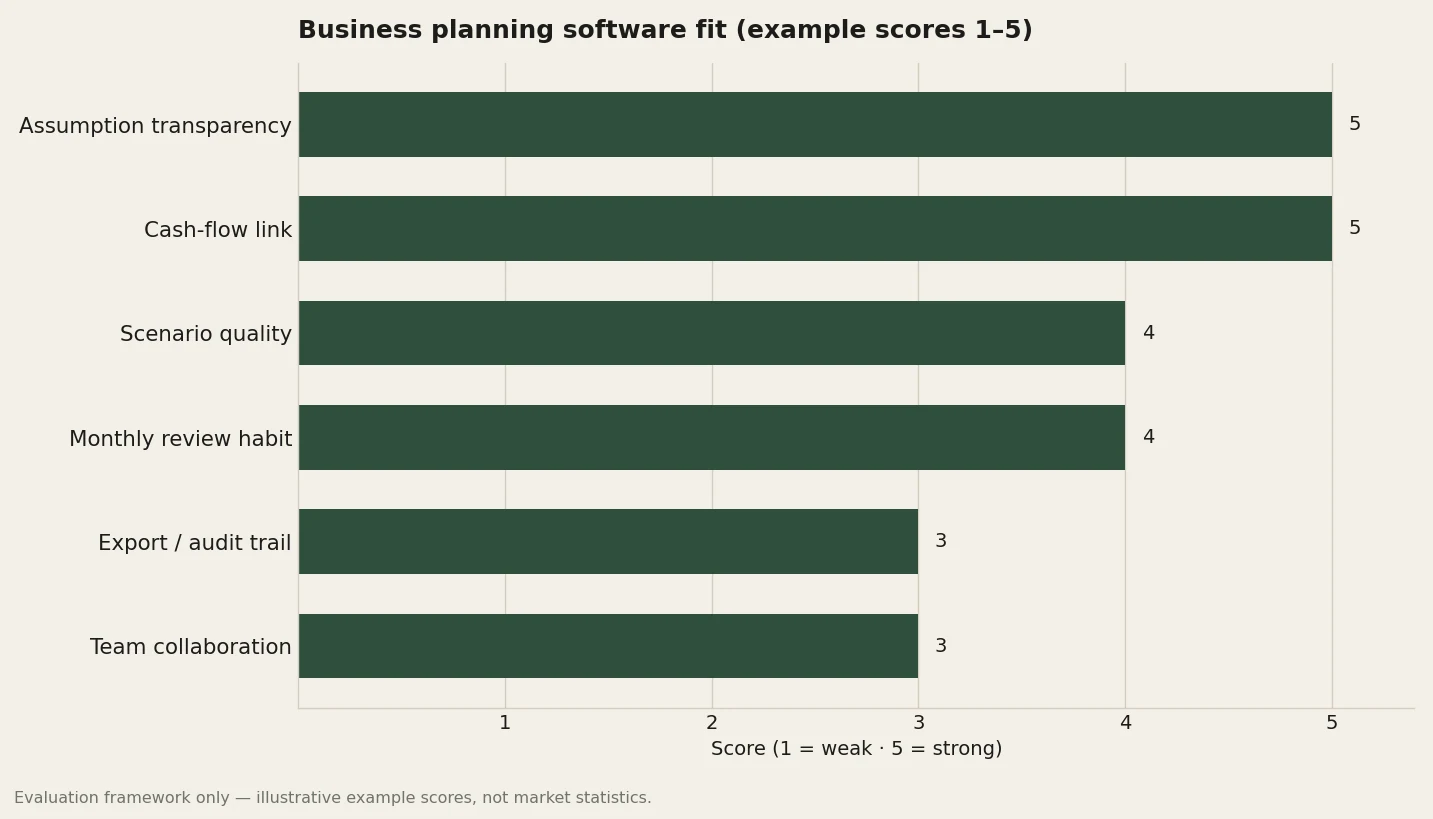
Decision rubric (score 1–5 yourself)
Score each row before renewing a planning subscription. Under about 18: fix the monthly review habit and assumption ownership first. Above about 22 with a named finance owner: a structured tool can help.
| Axis | 1 = weak fit | 5 = strong fit | Your score |
|---|---|---|---|
| Assumption transparency | Black-box outputs | Drivers visible and explainable | ___ |
| Cash-flow link | P&L without cash | Working capital and runway visible | ___ |
| Scenario quality | One optimistic case | Comparable base / downside / upside | ___ |
| Monthly review habit | Plan filed and forgotten | Plan vs actual reviewed monthly | ___ |
| Export / audit trail | Screenshots only | Exports and version history usable | ___ |
| Team collaboration | Founder-only model | Reviewers can challenge assumptions | ___ |
What a CA looks for in a planning tool
Scenario modelling that changes cash conclusions, not just slide charts. Cash-flow visibility that includes working capital, not only accrual profit. Collaboration that allows challenge without chaos. Exportability for lenders, boards or advisors. An audit trail of what changed and why. Integrations that reduce re-keying without hiding errors. Total cost that includes the hours of operating the model.
Test the product with your own numbers. Pay particular attention to local tax, invoicing and reporting requirements. A beautiful fundraising deck template does not equal a controllable forecast. The best tool is the one the management team reviews every month: update actuals, explain variances, refresh the rolling forecast and record decisions.
Monday-morning checklist
- Open the live plan and confirm the date of the last actuals update.
- Explain one revenue driver and its path to cash in two minutes.
- Refresh base / downside / upside with one changed assumption each.
- Write the variance story for last month in five bullets maximum.
- Log one decision or kill one unused planning seat.
Monthly operating rhythm
Week one after close: load actuals, flag variances above your threshold. Mid-month: revise near-term cash and hiring or spend decisions. Month-end: lock a version, store commentary, and decide what the next four weeks will test. Keep the assumption register in a place the team can find — Notion works for that narrative layer if the model remains the calculator.
When AI features suggest drivers or narrative text, treat them as drafts. Cross-check against contracts, pipeline reality and accounting actuals. Invented precision is worse than honest ranges.
Common failure modes
Building a plan for fundraising and never updating it. Confusing presentation polish with forecast quality. Ignoring cash while celebrating accrual profit. Letting AI write the narrative before the numbers reconcile. Avoidance is a monthly calendar invite with actuals open and a written decision log.
What this review is not
This is an educational review, not financial or investment advice. Pricing, features and partner terms must be verified directly with the vendor before purchase.
How to review progress after four weeks
At the end of a controlled trial, write a one-page note a sceptical finance partner can read. Cover what you attempted, what evidence you produced, what changed in operating behaviour, and whether the tool or workflow should be renewed, narrowed or cancelled. Prefer concrete artefacts — decision logs, exception lists, shipped actions — over vanity dashboards. If you cannot produce that note, the experiment is incomplete regardless of how impressive demos looked.
Carry forward only the workflows with a named owner and a metric you already manage. Archive unused seats, unused templates and unused tracking lists. Tool sprawl is a quiet tax on attention; a shorter stack with weekly discipline usually beats a broad stack that nobody operates.
How to review progress after four weeks
At the end of a controlled trial, write a one-page note a sceptical finance partner can read. Cover what you attempted, what evidence you produced, what changed in operating behaviour, and whether the tool or workflow should be renewed, narrowed or cancelled. Prefer concrete artefacts — decision logs, exception lists, shipped actions — over vanity dashboards. If you cannot produce that note, the experiment is incomplete regardless of how impressive demos looked.
Carry forward only the workflows with a named owner and a metric you already manage. Archive unused seats, unused templates and unused tracking lists. Tool sprawl is a quiet tax on attention; a shorter stack with weekly discipline usually beats a broad stack that nobody operates. Put the renew/kill decision on the calendar so it is not postponed by another shiny pilot.
If the note shows partial value, narrow scope rather than expanding seats. Keep the one workflow that moved a metric, document the SOP, and pause everything else. Partial success is still success when it becomes an operating habit instead of a slide in a quarterly update.