AI can make financial analysis faster, but speed is not the same as accuracy. The analyst still owns the question, the quality of the source data, the interpretation of uncertainty and the final decision. A useful system improves research without disguising assumptions as facts.
The strongest use cases are structured: extracting figures from filings, comparing period-on-period movements, classifying disclosures, building a first-pass peer table, summarising research notes and monitoring defined indicators. For ecommerce operators comparing settlement, returns, inventory and reporting workflows, see the ecommerce accounting automation guide. These tasks benefit from repeatable inputs and a clear review step. Semrush can be relevant for analysing digital demand signals, competitor visibility and category trends. Notion can provide a research workspace with a source register, thesis log and review checklist. Every important number should still be traced to an original filing, exchange disclosure, company communication or other authoritative source.
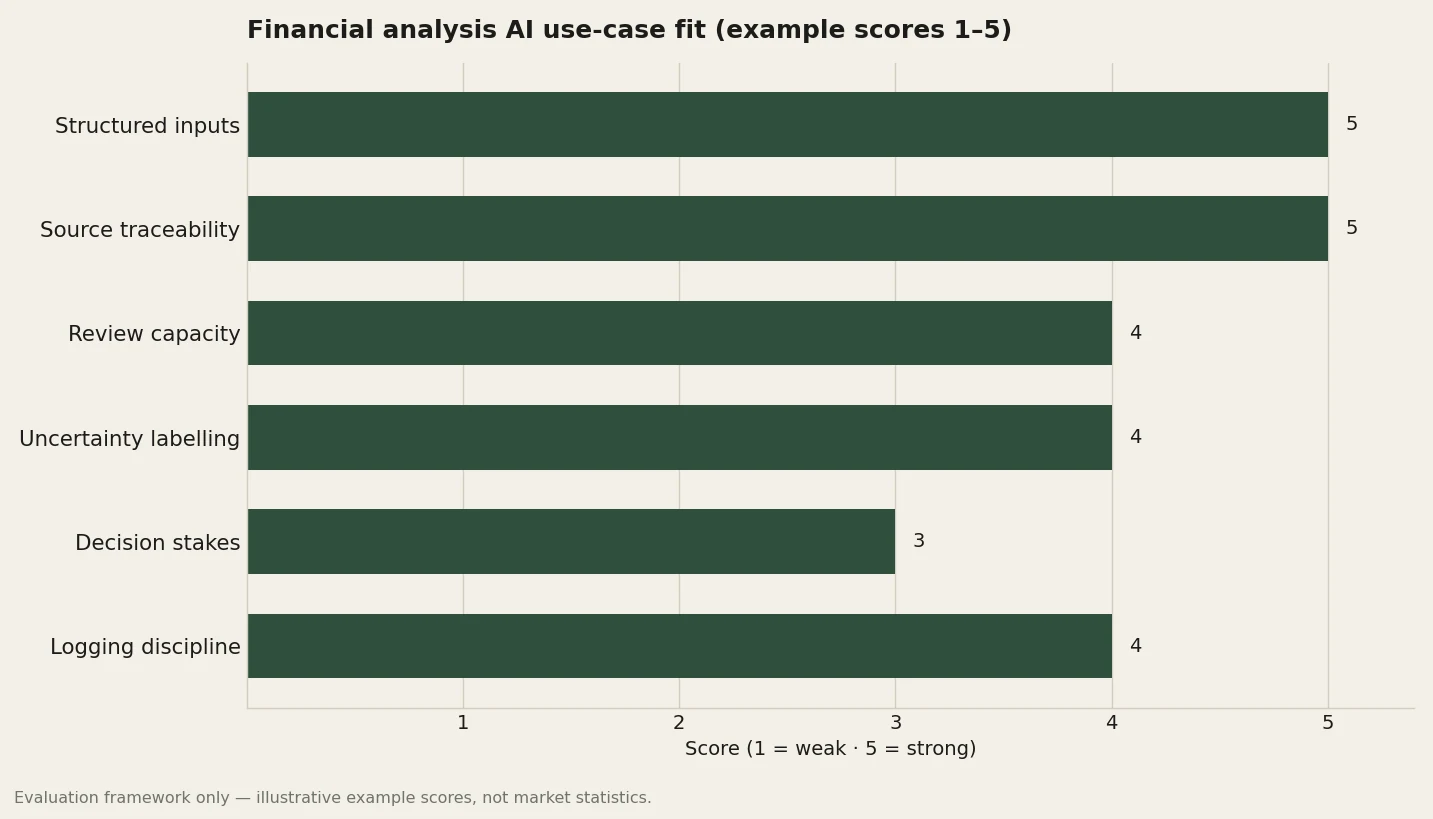
Decision rubric (score 1–5 yourself)
Score each row before treating model output as decision-ready. Under about 18: keep AI in draft mode only. Above about 22 with a named reviewer: limited production use for defined tasks is reasonable.
| Axis | 1 = weak fit | 5 = strong fit | Your score |
|---|---|---|---|
| Structured inputs | Messy unstructured notes only | Filings, statements and defined extracts | ___ |
| Source traceability | Numbers without citations | Every key figure links to an original source | ___ |
| Review capacity | Nobody checks model output | Named reviewer before decisions | ___ |
| Uncertainty labelling | Confident tone hiding gaps | Assumptions and missing data stated plainly | ___ |
| Decision stakes | Casual browsing only | Outputs influence capital or client advice | ___ |
| Logging discipline | Chat history as “audit trail” | Thesis log with dates and revisions | ___ |
Practical use cases that deserve a pilot
First-pass extraction of tables from lengthy filings for human verification. Draft peer comparison shells that you then populate from primary sources. Classification of disclosure themes for later reading. Summaries of your own research notes into a decision memo template. Monitoring of defined digital demand signals that may corroborate or challenge a commercial thesis — never as a substitute for financial statements.
Models can hallucinate figures, confuse similarly named companies, miss footnotes and overstate conclusions. For retail investors and students of markets, the right output is an educational framework: what changed, why it may have changed, what could disconfirm the interpretation and what information is missing. That framing protects judgement better than a confident paragraph without citations.
Monday-morning checklist
- Open one live thesis note with the decision question and the mandatory sources list.
- Trace every material number in yesterday’s AI-assisted draft back to a primary source.
- Label uncertainty: assumptions, missing data and alternative explanations.
- Run one peer or period comparison using filings — not model memory.
- Update the review checklist: what a second person must verify before any action.
Controls for YMYL financial content
Separate educational analysis from personalised investment advice. Do not let tools invent performance claims, guaranteed outcomes or “sure” recommendations. Keep a thesis log with dates: what you believed, what evidence supported it, and what would falsify it. If you advise clients professionally, your firm’s standards and regulatory obligations still govern — software does not dilute accountability.
For India-facing readers, investor-protection education from SEBI is a better starting point than anonymous market commentary. Digital demand tools may inform commercial or competitive questions; they are not a substitute for exchange disclosures or audited financials.
Common failure modes
Copying model-generated ratios into memos without filings open. Treating chat history as an audit trail. Using SEO visibility as a proxy for fundamental quality. Asking AI for a buy/sell call and calling it analysis. Avoidance is disciplined: sources first, drafts second, human review always, and clear educational boundaries.
What this guide is not
This article is for education only and is not a recommendation to buy, sell or hold any security. Markets involve risk; consult a suitably authorised professional for advice specific to your circumstances.
How to review progress after four weeks
At the end of a controlled trial, write a one-page note a sceptical finance partner can read. Cover what you attempted, what evidence you produced, what changed in operating behaviour, and whether the tool should be renewed, downgraded or cancelled. Prefer concrete artefacts — decision logs, exception lists, shipped actions — over vanity dashboards. If you cannot produce that note, the experiment is incomplete regardless of how impressive demos looked.
Carry forward only the workflows with a named owner and a metric you already manage. Archive unused seats and unused tracking lists. Tool sprawl is a quiet tax on attention; a shorter stack with weekly discipline usually beats a broad stack that nobody operates.
How to review progress after four weeks
At the end of a controlled trial, write a one-page note a sceptical finance partner can read. Cover what you attempted, what evidence you produced, what changed in operating behaviour, and whether the tool or workflow should be renewed, narrowed or cancelled. Prefer concrete artefacts — decision logs, exception lists, shipped actions — over vanity dashboards. If you cannot produce that note, the experiment is incomplete regardless of how impressive demos looked.
Carry forward only the workflows with a named owner and a metric you already manage. Archive unused seats, unused templates and unused tracking lists. Tool sprawl is a quiet tax on attention; a shorter stack with weekly discipline usually beats a broad stack that nobody operates.